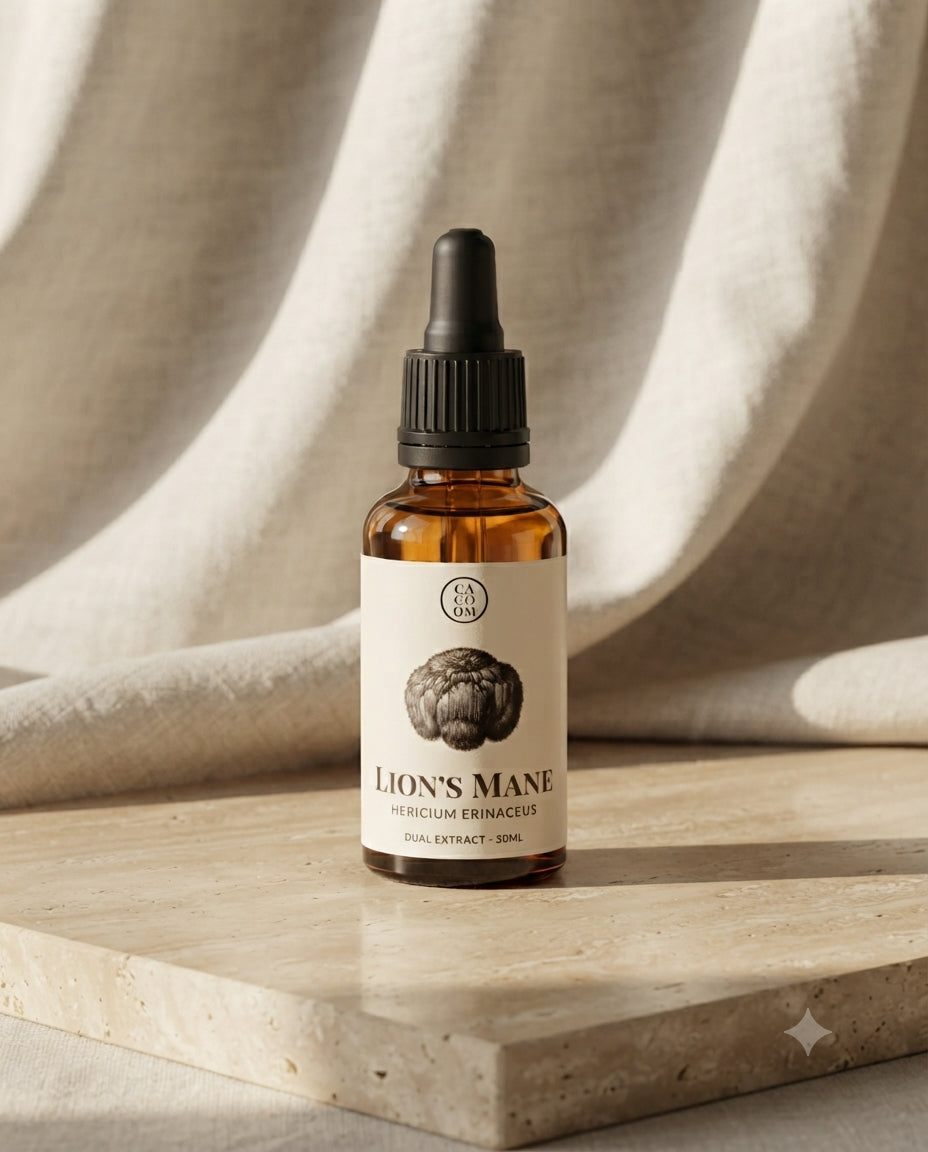
Lion’s Mane in Cacao – Why This Combination Makes Sense
Functional cacao blends have become more visible in recent years, often positioned as alternatives to coffee or as part of daily focus rituals. Among the most common formulations is cacao combined with Lion’s Mane mushroom.
This pairing raises a reasonable question: is it primarily a lifestyle trend, or is there a functional rationale behind combining these two ingredients? To explore that, it helps to look beyond flavour and aesthetics and consider how this combination fits into modern approaches to mental clarity.
Understanding the combination of Lion’s Mane and cacao
Lion’s Mane and cacao are increasingly combined in functional drinks and cacao-based blends. While the pairing may appear trend-driven at first glance, it is rooted in a broader context that includes ingredient compatibility, traditional usage patterns and current scientific research.
Rather than focusing on immediate effects or performance outcomes, this combination is best understood through its formulation logic and the way both ingredients are typically consumed. From a scientific and practical perspective, its relevance lies not in novelty, but in how a researched functional mushroom is integrated into a familiar, food-based format.
This section outlines why Lion’s Mane and cacao are often used together and how their respective characteristics complement each other.
Why Lion’s Mane and cacao are often combined in functional drinks
Lion’s Mane (Hericium erinaceus) is a functional mushroom that has been studied for its bioactive compounds, including hericenones and erinacines. These compounds are frequently discussed in neurological and neurochemical research contexts, with studies exploring Lion’s Mane in relation to the nervous system, cognition and brain health while emphasising that research in this field remains ongoing and evolving.
Cacao, by contrast, has a long history as a food rather than a supplement. It naturally contains compounds such as flavanols and theobromine and has traditionally been consumed as a warm beverage in various cultures, often integrated into daily routines and social contexts rather than positioned as a targeted stimulant.
When combined in functional drinks, these two ingredients bring together a researched functional component and a widely accepted food base. This makes the pairing approachable and compatible with regular consumption patterns, which is a key reason it appears in beverage formats rather than capsules or tablets.
A pairing beyond immediate effects
The combination of Lion’s Mane and cacao is not designed around rapid or pronounced effects. Instead, it is often positioned within a broader functional framework that prioritises consistency, familiarity and long-term use over intensity or immediacy.
From a formulation perspective, this pairing supports a food-first approach. Rather than isolating compounds or concentrating on short-term outcomes, the blend fits into a context where ingredients are consumed slowly and intentionally, distinguishing it from products marketed around instant stimulation or performance enhancement.
The functional role of cacao
Cacao plays a central role in functional cacao blends beyond taste alone. Its composition, traditional use and preparation format influence how functional ingredients are experienced and integrated into daily life, making it more than a neutral flavouring agent.
This section explores cacao’s role as a carrier ingredient and explains why its traditional preparation as a warm beverage shapes the overall experience of functional drinks.
Cacao as a carrier for functional ingredients
In functional blends, cacao serves as a carrier that helps integrate additional ingredients into a cohesive food format. Its natural fat content, fibre and polyphenols contribute to texture and mouthfeel, creating a balanced base that can accommodate powdered plant and mushroom ingredients without requiring encapsulation.
From a formulation standpoint, cacao allows functional ingredients to be consumed as part of a complete food rather than as isolated compounds. This aligns with perspectives in nutritional science that consider food matrices and consumption context relevant to how ingredients are experienced and perceived.
Why warm drinks change the experience
Unlike capsules or powders taken in isolation, cacao is typically consumed slowly as part of a warm drink. This introduces a temporal and sensory dimension that differs significantly from quick-intake formats.
Warm beverages engage taste, aroma and temperature, contributing to a smoother sensory experience and a more gradual intake. While this does not imply specific physiological outcomes, it clearly differentiates the experience from fast-acting stimulants or concentrated supplements.
From supplementation to ritual
Cacao also shapes behaviour around functional products by framing them within a familiar food ritual. Preparing and consuming a warm drink reduces the perception of supplementation as a task and supports intentional, repeatable use.
This ritual aspect is one reason cacao-based blends are often preferred over pills or shots. From a practical perspective, this approach supports consistency and long-term integration into daily routines without relying on urgency or performance-driven messaging.
Focus without overstimulation
Many people exploring Lion’s Mane cacao blends are not seeking stimulation in the traditional sense. Instead, interest often centres on mental clarity that feels stable, balanced and compatible with everyday routines.
This section examines why cacao-based blends are frequently positioned as alternatives to stronger stimulants.
A different approach to mental clarity
Conventional stimulants are often associated with sharp increases in alertness followed by noticeable declines. In contrast, Lion’s Mane cacao blends are typically discussed in the context of steadiness rather than intensity.
This positioning reflects a broader shift toward functional foods that support focus without overwhelming the nervous system, fitting more naturally into moments that benefit from calm concentration.
The role of cacao in non-jittery focus
Cacao contains theobromine, a compound structurally related to caffeine but generally described as milder in its stimulant profile. Theobromine is slower-acting and commonly associated with a less pronounced impact on the central nervous system compared to caffeine.
In functional cacao blends, cacao is not intended to replace coffee outright. Instead, it offers an alternative that fits better into certain contexts, particularly for those who prefer gentler stimulation or wish to avoid stronger stimulants later in the day.
Context, positioning and responsibility
Functional blends are often dismissed as lifestyle trends, especially in a market crowded with nootropics and quick-fix solutions. However, the combination of Lion’s Mane and cacao stands apart from many novelty-driven concepts when viewed through a broader historical and scientific lens.
This section addresses the importance of context, long-term use and responsible communication.
Why this is not just a lifestyle trend
Both Lion’s Mane and cacao have histories that extend well beyond modern wellness marketing. Cacao has been consumed as a food for centuries, while Lion’s Mane appears in both traditional systems and contemporary research literature.
The renewed interest in this combination reflects changing lifestyles rather than sudden discovery, as cognitively demanding routines drive interest in food-based approaches that integrate smoothly into existing habits.
Long-term use versus quick fixes
Short-term solutions often dominate wellness trends, but long-term dietary habits tend to have greater relevance. The combination of Lion’s Mane and cacao aligns with this perspective by emphasising regular use within a familiar food format rather than episodic supplementation.
Scientific research in this area continues to develop, and responsible formulations recognise the distinction between emerging evidence and established conclusions as essential for credibility and trust.
A science-informed approach
A science-informed approach draws on existing research without overstating conclusions. Reviews and clinical studies on cacao flavanols, theobromine and Lion’s Mane compounds provide valuable context, but they do not justify sweeping claims.
For this reason, responsible formulations focus on ingredient quality, transparency and alignment with current scientific understanding rather than promises of specific outcomes. Readers interested in the research background can explore peer-reviewed studies and reviews via established scientific databases.
Conclusion
Lion’s Mane in cacao can be understood as a calm and intentional alternative to more stimulating approaches. Viewed through biological, practical and cultural lenses, the combination reflects a food-based strategy that values consistency, ritual and integration into daily life.
By pairing a researched functional mushroom with a familiar cacao base, these blends offer an approach to focus that prioritises steadiness and intention over intensity, fitting naturally into modern routines without reliance on novelty or exaggerated claims.

Von Nori
Nori is the CEO and founder of Cacoom.